Saturday, January 21, 2012

Trip to vaishnodevi, Jammu & Kashmir, Amritsar, Kurukshetra and New Delhi

VAISHNODEVI
We started vaishnodevi trek by 9.30 am and reached Bhawan around 2.30pm. had good darshan of mata rani. left downwards by 7.00pm and reached Katra by 10.30pm. there are dolis, horses and helicopter services from Katra to Vaishnodevi.
The temple is near the town of Katra in the state of jammu and Kashmir. It is one of the sacred places of worship in India. The shrine is at an altitude of 5200 feet and a distance of approximately 14 kilometres from katra. The Shri Mata Vaishno Devi Shrine Board maintains the shrine. The nearest airport is Jammu Airport. All leading domestic airlines have their services to Jammu Airport.
According to mythology Maa Vaishno Devi was born in the south of India  in the home of Ratnakar Sagar. Her worldly parents had remained childless for a long time. Ratnakar had promised, the night before the birth of the Divine child, that he would not interfere with whatever his child desired. Ma Vaishno Devi was called Trikuta as a child. Later She was called Vaishnavi because of Her taking birth from Lord Vishnu's lineage. When Trikuta was 9 years old, She sought her father's permission for doing penance on the seashore. Trikuta prayed to Lord Vishnu in the form of Rama. During Shree Rama's search for Sita, He reached the seashore along with His army. His eyes fell on this Divine Girl in deep meditation. Trikuta told Shree Rama that She had accepted Him as Her husband. Shree Rama told Her that during this incarnation he had vowed to be ekapatnivratastha. In the meantime Shree Rama asked Trikuta to meditate in the cave found in the Trikuta Range of Manik Mountains, situated in Northern India. Lord Ram gave her a bow and arrows, army of monkeys and a lion for her protection. Lord Rama also said Trikuta would become famous as Vaishno Devi and would become immortal forever.
With the passage of time many more stories about the Mother Goddess emerged. One such story is about Sridhar.
Sridhar was an ardent devotee of Ma Vaishno Devi. He resided in a village called Hansali. Once Ma appeared to him in the form of a young bewitching girl. The young girl asked the humble Pandit to hold a 'Bhandara'. (A feast to feed the mendicants and devotees) The Pandit set out to invite people from the village and near-by places. He also invited 'Bhairav Nath' a selfish tantrik. Bhairav Nath asked Sridhar how he was planning to fulfil the requirements. He reminded him of the bad consequences in case of failure. As Panditji was lost in worry, the Divine girl appeared and told Him not to be worried as everything had been arranged. She asked that over 360 devotees be seated in the small hut. True to Her word the Bhandara went smoothly with food and place to spare. Bhairav Nath admitted that the girl had supernatural powers and decided to test Her further. He followed the Divine girl to Trikuta Hills. For 9 months Bhairav Nath was searching for the mystic girl in the mountains, whom he believed was an incarnation of the Mother Goddess. While running away from Bhairav, Devi shot an arrow into the Earth from which water gushed outand formed river known as Baanganga. It is believed that by taking a bath in Baanganga (Baan: Arrow), a believer of the Mother Goddess can wash away all his sins. The banks of the river, known as Charan Paduka, are marked by Devi's foot imprints, which remains intact till date. Vaishno Devi then took shelter in a cave known as Garbh Joon near Adhkawari where she meditated for 9 months attaining spiritual wisdom and powers. Her meditation was cut short when Bhairav located her. Vaishno Devi was then compelled to take the form of Maha Kali when Bhairav tried to kill her. The manifestation of the Mother Goddess took place at the mouth of the Holy cave at Darbar. The Goddess then beheaded Bhairav with such sheer force that his skull fell at a place known as Bhairav Ghati, 2.5 km from the Holy Cave.
In his dying moments, Bhairav pleaded for forgiveness. The Goddess knew that Bhairav's main intention in attacking her was to achieve salvation. She not only granted Bhairav liberation from the cycle of reincarnation, but also granted him a boon, whereby every devotee, in order to ensure completion of the pilgrimage, had to visit Bhairav Nath's temple near the Holy cave after the darshan of the Goddess. Meanwhile Vaishno Devi assumed the shape of a rock with three pindis (heads) and immersed herself into meditation forever.
Meanwhile, Pandit Sridhar became impatient. He started to march towards Trikuta Mountain on the same path that he had witnessed in a dream. He ultimately reached the cave mouth. He made a daily routine of worshipping the 'Pindis' in several ways. His worship pleased the Goddess. She appeared in front of him and blessed him. Since that day, Sridhar and his descendants have been worshipping the Goddess Mother Vaishno Devi. it is believed that no one goes empty handed fro the pilgrimage of mata vaishnodevi.

Tuesday, October 25, 2011

Tiruvannamalai Girivalam

The Arunachaleswarar temple at Tiruvannamalai is a very ancient temple in Tamil Nadu.This has great reputation among all Shiva devotees since Arunachalaeswar is prayed here in the form of fire, fire being one of the five elements that composed this universe. The other four elements of the panchaboothas are vayu, akash, jalam and earth.This beautiful temple is located at the foot of the Annamalai hills that falls under the Tiruvannamalai district This god being believed to be part of the hill, hence it is also called as Annamalayar among its devotees. Every full moon day of the month Girivalam is undertaken by the pilgrims. Lakhs of devotees participate every month in this healthy ritual. This word Girivalam is the origin of the tamil word giri meaning hill and valam means coming around. Hence coming around the hill is called as Girivalam in Tamil. To come one full round (Girivalam) the road round the hill, it is around 14 kilometres.It is believed this hills took different forms at different period of time and age. During the krutha yuga it was in the form of fire. The next treta yuga it took the form of emerald. In  dwapara yuga it existed in the form of gold.In kaliyuga it in the form of rocky hill.
At Arunachaleswarar temple there are eight lingams known as Ashtalingam. They are positioned at different locations and facing various directions. Each lingam signifying different directions of the earth. These lingams are named as Indralingam, Agnilingam, Yamalingam, Niruthilingam, Varunalingam, Vayulingam, Kuberalingam and Esanyalingam
The first lingam on the Girivalam is the Indra lingam and this lingam has east as its cardinal direction. It is said to be installed by lord Indra the celestial king
The second lingam on the Girivalam is the Agni lingam. This faces the south east direction. The uniqueness of this lingam is that it is the only lingam that is placed on the right side of the path on which one goes Girivalam on the full moon night every month. 
The third lingam on the Girivalam is the Yama lingam. This lingam signifies the south direction. It is said to be installed by the god of death Yama.
The fourth lingam on the Girivalam is the Niruthi lingam. The cardinal direction is South East. This was installed by the king of the giants
The fifth lingam on the Girivalam is the Varuna lingam. This lingam signifies the west direction. This lingam is installed by the Varuna god who is the creator of rain on this earth. 
The sixth lingam on the Girivalam is the Vayu lingam. This lingam is placed facing the north west direction. Vayu lingam is installed by the god of air himself known as Vayu . 
The seventh lingam on the Girivalam is the kuberalingam. This faces the northern direction.  kubera or the god of wealth has installed this lingam.
The last lingam on the Girivalam is the Esanya lingam. And this lingam faces the north east direction. The god that installed this lingam is the Esanyan.
other attractions of tiruvannamalai are 
Skandashramam in Thiruvannamalai town is located on the north side of the Arunachala hill where the famous Arunachaleswara temple exists. This ashram is also near to the renowned Ramana Ashram. This is one of the caves where the saint Ramana spent his period of stay in Thiruvannamalai. Virupaksha Cave , arunachaleshwara temple, satnoor dam, seshadri swamigal ashram, ramana ashram, gingee fort.

Tuesday, December 7, 2010

trip to Gujrat

Myself , husband and my daughter went on a beautiful pilgrimage to Gujrat with our relatives on 26/11/2010 by indigo flight at 5pm but the flight was delayed and we reached ahmedabad around 9 pm. halted at hotel Resident , good hotel with decent rooms and good service. 


matrugaya

bindu sarovar
Day 2 left hotel by 12 seater Tempo Traveller at 6am to Sidhpur reached at 9am. Sidhpur is around 103 kms north of ahmedabad. in ancient period Sidhpur was known as Shristhal, where famous Bindu Sarovar lake lies. here Mathru shraddas are performed in the place called Mathru Gaya.They are performed at Kapilamuni Ashram, where 3 sacred water kunds: the Gyan Vapika, Alpa Sarovar and Bindu Sarovar are present. It is also said that Lord Parshuram performed ‘Matru Shraddh’ at the Bindu Sarovar and his temple is also created here for darshan (worship).
later we proceeded to  Ambaji which is 79 kms. 
Shri Arasuri Ambaji Mata  Temple is the origin of the Supreme Cosmic Power of the Universe.This Temple is one of the 51  famous Ancient Shakti Piths of goddess Parvati Devi. there is no idol of mataji here but only Shree visa yantra is placed. no one can see this yantra or photographed in the past or in future. 
Just 5 km away from Ambaji Temple, The famous mountain of Gabbar is situated on the border of States of Gujarat and Rajasthan, at the altitude of about 480 meters, at about 1600 feet high from sea level,with 999 steps. and it is the original holy place of Mata Ambaji, where the piece of the heart of the dead body of Devi Sati fell at the top of this holy hill of Gabbar .

ambaji mandir

Bangles can be tied to pole by sumangalis for wellness of Soubhagya.
hilltop ambaji mandir
ropeway at gabbar hill

Hilltop where akhand lamp is lighted at Gabbar hills. those who cannot climb steps they can go by ropeway which costs about 75 rupees per head to rhe hilltop. later left for Ahmedabad enroute we visited Jain temples which is 1200 years old with beautiful architecture and marble carvings.
jain temple


reached Ahmedabad by 8.30pm had buffet dinner at Hotel Fortune Landmark  organised by Aunt's family friend . Halt at Hotel Resident.
next day i.e. on 28/11/2010 we visited to Sabarmati Ashram also known as Gandhiji Ashram located in Ashram Road at the bank of river Sabarmati in Ahmedabad.This ashram is now a national monument by the Government of India due to its significance in the Indian independence movement in the form of the Dandi March in 1930.
charaka
sabarmati river


sabarmati ashram
later left to Akshardham dedicated to Lord Swaminarayan . due to security reasons cameras, mobiles leather purses are not allowed inside therefore cold not take photos or videos there. monument is made of pink sandstone with serene enviroment.Harimandap is murti of Swaminarayan which is goldplated.there are vibhutimandap and prasadimandap also. there are exhibition halls where life and teachings of Swaminarayan are showed . 
then left for our much awaited journey to SOMNATH. which is 450 kms from Ahmedabad approximately 9-10 hours journey. reached Veraval around midnight , halt at hotel Rajdhani which is average hotel with good staff. 
29/11/2010 lefy for Somnath darshan early in the morning by 6.30 am as it was Monday and last Karthik somwar. we had good darshan and attended arathi as we first in queue, performed pooja, visited mool mandir.
somnath temple is at the shore of Arabian sea in western india, in Prabhas patan nearby veraval in Gujrat.
this is the first of tge Twelve Jyothirlingas.places to see in Somnath are somnath mandir, moolmandir Ahilyabai mandir, Bhalkathirth and several small temples. best season to visit are winters from october to March.
our group in front of somnath mandir
.
somnath mandir
bal gangeshwar


Bhalka thirth
Shri Krishna was fatally wounded by the arrow of a hunter  named Jara here while resting on a deerskin under a pipal tree. The poacher mistook the foot of the Lord as that of a deer and shot straight through it.  After being hit by the poacher Lord Shri Krishna made his journey at the holy confluence of the three rivers namely Hiran, Kapila and Saraswati.
en route to Dwarka visited Porbander which is 130 kms approximately ,places of interest are  Gandhiji's Kirti Mandir, Sudama Mandir, Bharat Mandir. 
kirtimandir
Porbander to Dwarka is around 100 kms reached Dwarka by evening . had Darshan and arathi of Dwarkadeesh in evening . Dwarka is located on the western coast of Gujarat on the shore of the Arabian Sea. Dwarka is famous for the Dwarkadheesh temple (Jagat Mandir) on the bank of the Gomti River .Dwarka is one of seven most holy places for Hindus in India Adi Sankara had visited Dwarakdish Shrine and had established the Dwarka peeth. 
The present temple was built in 16th century while the original temple was believed to have been built by Krishna's grandson, Vajranabha. The 5-storied temple is made of limestone and sand. A flag hoisted in the temple tower five times each day. There are two gateways - Swarga Dwar, where pilgrims enter, and Moksha Dwar, where pilgrims exit. From the temple one can view the Sangam (confluence) of River Gomati flowing towards the sea. In Dwaraka, there are also shrines for Vasudeva, Devaki, Balarama and Revati, Subhadra, Rukmini Devi, Jambavati Devi and Satyabhama Devi.There is a special temple for Rukmini Devi on the way to Bet Dwarka temple, which can be reached by boat. A similar deity of Lord Dwarakanath is also kept in Bet Dwaraka. The temple has many Shrines for Lakshmi Narayana, Trivikrama, Jambavati Devi, Satyabhama Devi and Rukmini Devi.
halt at TORAN tourist bungalow with good amenities also serves gujrati thali with reasonable amount.
30/11/2010-  Proceeded to Bet dwarka in the Morning   Bet Dwarka is famous for its temples dedicated to Lord Krishna and is of great importance in the ancient Hindu tradition.The  religious capital is believed to have submerged under the sea after the Krishna left dwarka for vaikunth. 
Rukmini mandir

The story of this temple is that one day, Durvasa Muni was invited by Lord Krishna and his wife, Rukmini, for lunch. Durvas asks Lord Krishna and Rukmini to pull the chariot as he does not sit on horse rid chariots. Krishna and Rukmini obliges, On the way to palace for lunch Rukmini becomes thirsty and asked Krishna for help. Krishna then put his foot in the ground and the Ganges waters flowed from the earth while Rukmini was drinking the water, Durvasa sees and curses her to live apart from Lord Krishna, that there should be no sweet water in Dwarka .
Rukmini mandir


Gopi talav  is the pond where Lord Krishna met the gopis when they came to see him at Dwarka. The sacred clay from Gopi-talav  is known as gopi-candana and is used by devotees of Krishna to make the tilak marks on their bodies. It is 20km from Dwarka on the way to Bet Dwarka. 
Gopi Talav
then we proceeded to Nageshwar Jyothilinga. Nageshwar Temple or Nagnath Temple is located between  Dwarka and the Bet Dwarka Island on the coast of Saurashtra in Gujarat.
This is one of the twelve Jyothirlingas.
Nageshwar 
we left Nageshwar around 3 pm to Ahmedabad via Rajkot. we stayed at Rajkot in Hotel Ravi, good hotel with all modern amenities. 
1/12/2010-  Back to Bangalore from Ahmedabad by 5.30pm  indigo flight reached Bangalore at 7.30 pm.


Thursday, December 2, 2010

12 jyothirlingams of india

Jyothirlingams are the shrines worshipped to Lord Shiva. there are 12 jyothirlingams according to puranas each shrine having some story of lord shiva linked with that particular place.
12 jyorhitlingams are


1.Somnath in Gujrat
2.Mahakaleshwar in Ujjain
3.Mallikarjuna in Srisailam
4.Omkareshwar in Madhyapradesh
5.Vaidyanath in Parli (Jharkand)
6.Bhimashankar in Pune
7.Nageshwar in Dwarka
8.Ramalingeshwar in Rameshwaram
9.Vishwanath in Kashi (Varnasi)
10.Triambakeshwar in Nasik
11.Grushneshwar in Aurangabad
12. Kedarehwar in Kedar
Dwadasa Jyothirlinga stotra is a prayer composed by Adiguru Sri Shankaracharya addressing to Lord Shiva.
 sloka is as follows


Sourashtre somanthan cha srishaile mallikarjunam
ujjainam mahakalam omkaramamaleshwaram 
parliam vaidyanatham cha dakinayam bhimashankaram
sethubandethu ramesham nagesham darukavane
varanasanthu visvesham triambakam gauthami tathe
himalayathu kedaram grushnesam cha shivalaye
ethani jyothirlingani sayam prathaha patenarah
saptha janma krutham papam smaranena vinshyanthi


it is said that persons who are unable to visit these places recite this sloka every morning and evening all his sins are vanished is blessed by Lord Shiva.


SOMNATH


This temple is situated in Gujrat . somnath also calles prabhas kshetra is near veraval. this is one of the 12 jyothirlingas of our country. somnath temple is on the seashore. According to puranas this temple was built by Moon out of gold and then rebuilt by Ravana in silver and then by Krishna in Wood, then by Bhimdev in stone.
Moon God  constructed the temple after Lord Shiva cured him of his illness. This illness was caused by his father-in-law Daksha Prajapati's curse. Daksha cursed him to wane as he was attracted with only Rohini and was neglecting the other 26 wives, all 26 of whom were the daughters of Daksha Prajapati. It is said that Brahma advised him to build the temple in honor of Shiva.
Aurangzeb  destroyed the temple first and later renovated by maharani Ahalyabai .river saraswathi enters the sea here. most recently this temple was renovated by Sardar Vallabhai Patel in the year 1947 when he visited this place.
places to be visited near somnath is bhalka thirth , where a hunter shot  arrow at Lord Krishna's toe mistaking it as parrot and Lord ended his avatara here near pipal tree.
 nearby is a cave where Balarama, elder brother of Lord Krishna entered cave .

Friday, September 24, 2010

srichakra pooja at home


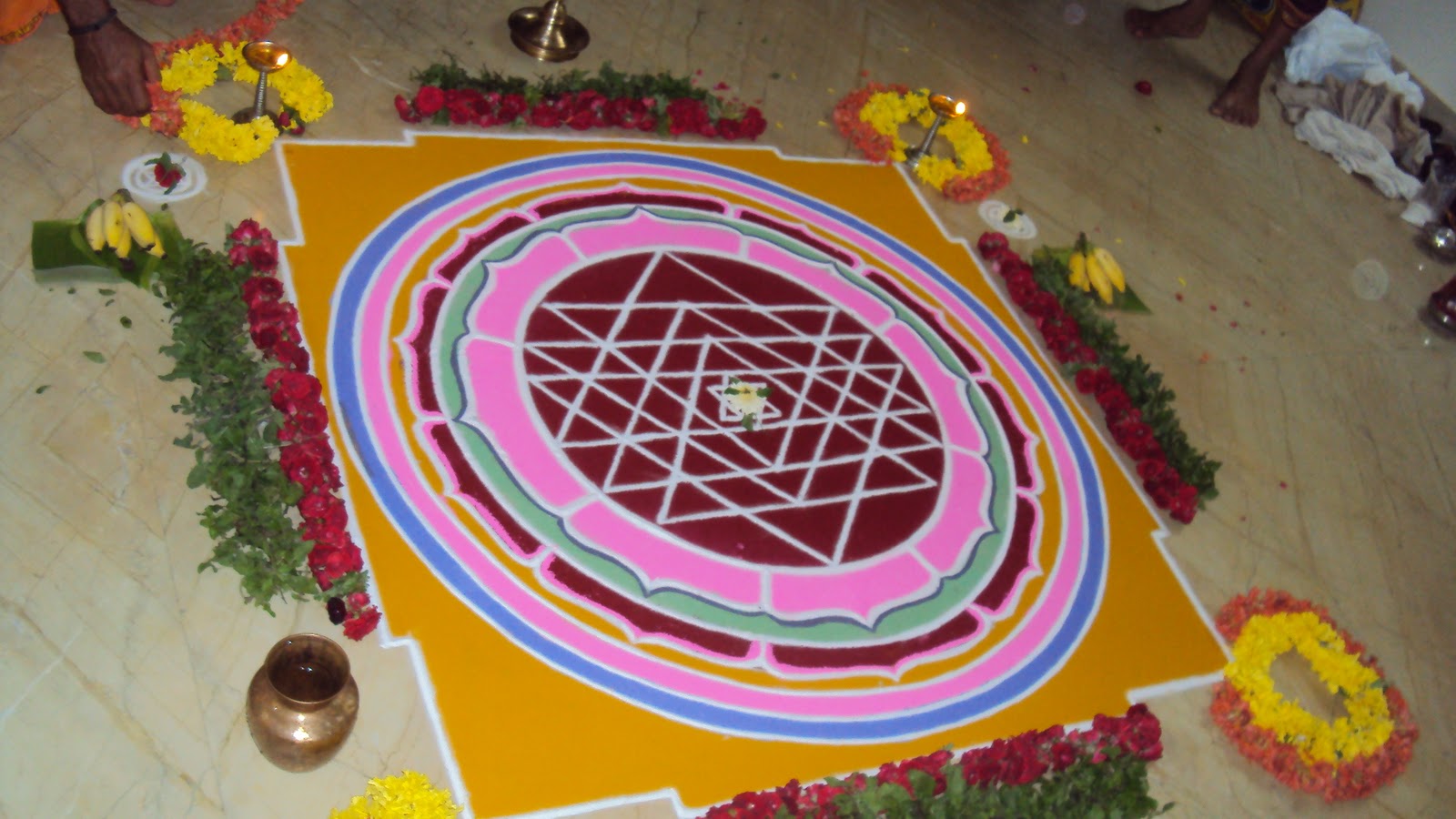
we performed Aslesha homa pooja and  srichakra pooja at home on 11/07/2010. it was a great evening to all of us.Sri Narasimha achar of Mangalore performed this for us.


vishwa shanthi ashrama bangalore

Vishwa Shanthi Ashram is located around 25 kms from Bangalore on Tumkur Road near Nelamangala Town.This was established by Sant Sadguru Keshavdas in 1982 to spread the teachings of the Gita and Bhakthi Yoga also to have peace across the globe. You can also find the tallest statue of Vijaya Vittala (36 feet), an incarnation of Lord Vishnu.


another attraction in this place is vishwaroopa darshan idol of lord vishnu Inside the temple all verses of Bhagavad Gita is written on black granite plate in Hindi, English and kannada. Below is a Gayathri devi temple. One can offer archana or puja here. it is very soothing and calm place to do one's japa or meditation.There is gitopadesham chariot  outside gita mandir, seven sea goddess,(ganga, yamuna, saraswathi, godavari,sindhu,narmada and  cauvery) devi durga ,lord anjaneya, lord Ganapathi, lord shiva, lord dattatreya ashtalakshmi, and the navagrahas in this premises . you can also find samadhi mandir of our guruji Sant keshavadasji.  

Friday, April 30, 2010

SONDA


Sonda is small village in the Sirsi taluk of Uttara Kannada district situated at a distance of around 450km from Bangalore and about 20km from Sirsi. It has three prominent Mutts: the Swarnavalli Mutt, the Vadiraj Mutt and theJain Mutt. Hundreds of pilgrims visit mostly through out the year
Places around Sonda,
Madhukeshwara Temple, Banavasi
Banavasi. which was once the capital of Kadamba rulers is situated at around 20km from Sirsi.The 9th Century Madhukeshwara temple of Banavasi is dedicated to Shiva. It is a big temple .There is a beautiful bull (Nandi) in front of Shiva but it appears to be watching Parvathi who is present in the adjoining temple.
Sahasralinga, Sonda
Sahasralinga, is approachable from Hulgol, on Sirsi-Yellapur road at around 15km from Sirsi.
Sonda Kote
Muttinakere Venkataramana Temple
Muttinakere is a small lake in Vaja Gadde area of Sonda.Near this lake is a small beautiful Venkataramana temple built in Vijayanagara style. 
Hunasehonda Venkataramana Temple
Shivagange Waterfall
sirsi marikamba temple
Vadiraj mutt, alight a few steps down near trivikrama temple is the mutt. bhootaraja temple is found here. Rolling of coconuts at bhootaraja temple is a tradition here, few people says it is our attendance to bhootaraja. men are supposed to take of their shirts and vests. there is a small pond in the temple premises. one has to take bath in the pond  then do parikrama in the wet clothes, all his desires will be fulfilled. 
Tapovana
Tapovana,is about 5 kms from the Mutt  and is on the banks of the river Shalmala.This is  the place where Sri Vadiraja Swamy used to sit down for his daily meditation. It was here  Sri Vadiraja Swamy used to meditate Lord Hayagriva with a plate of “Hayagriva Maddi”on his head.It is said that Lord used to come in the form of horse and eat the food offered to him by  Sri Vadiraja Swamy.